
Fetching financial insights...
•
•
•
•
•
•
Understand secured vs unsecured loans in India, including collateral requirements, interest rates, eligibility, benefits, risks, and practical examples.
Grofi Editorial
Senior Financial Analyst
When you need money for a home, education, a business expense, or an unexpected emergency, choosing the right loan can make a significant difference to your finances.
But before applying, you may encounter two common terms: secured loans and unsecured loans.
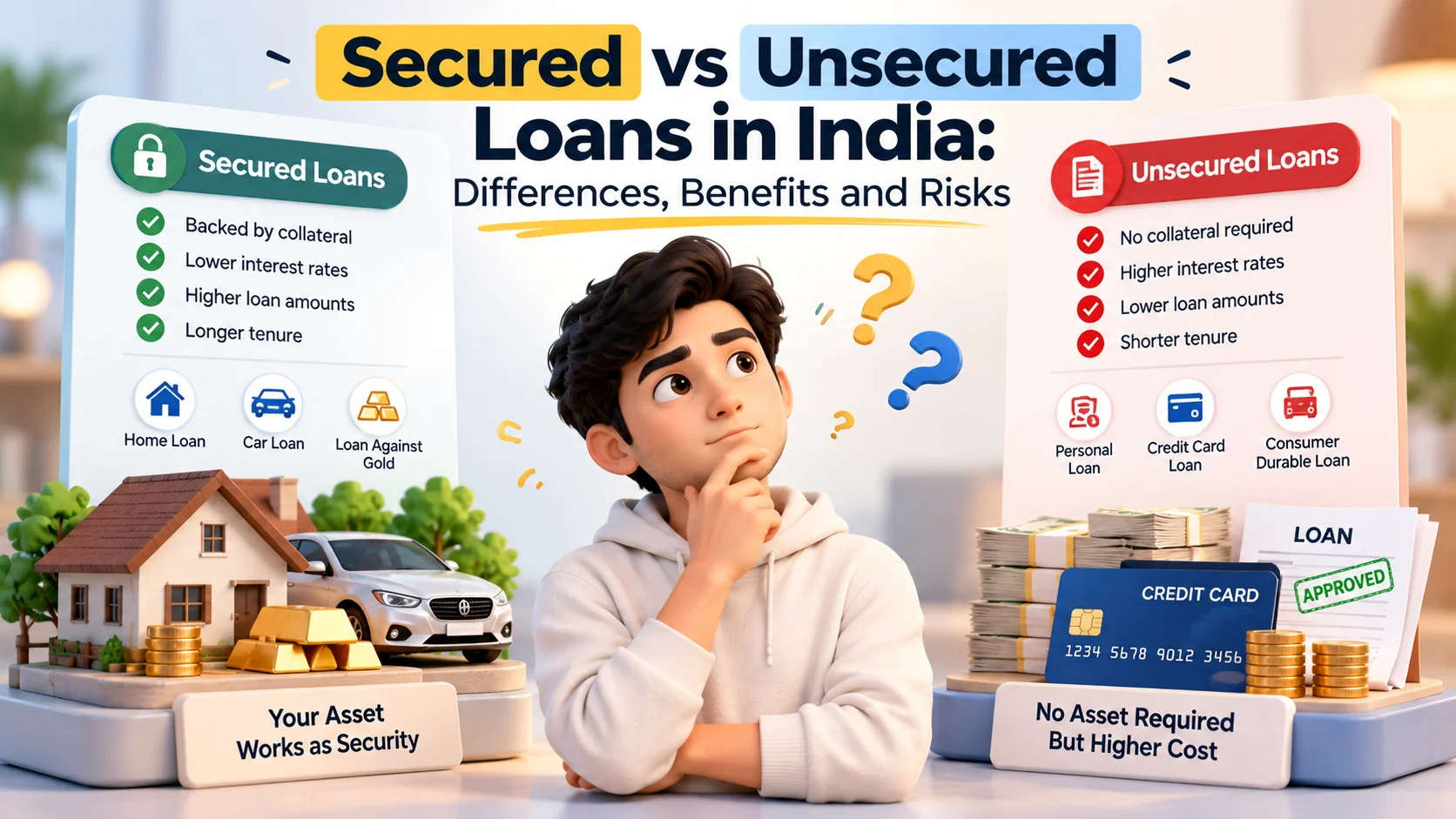
Both allow you to borrow money, but they work differently. A secured loan is backed by an asset, such as a house, vehicle, or gold. An unsecured loan does not require you to pledge a specific asset as collateral. Instead, the lender primarily evaluates factors such as your income, credit history, existing debt, and repayment capacity.
So, which option should you choose? Is a secured loan always cheaper? Are unsecured loans safer because you do not have to pledge property?
In this guide, we explain the differences between secured and unsecured loans in India, their advantages and disadvantages, real-world examples, and the factors to consider before borrowing. If you want to compare options as you read, you can explore personal loans on Grofi.
A secured loan is a loan backed by collateral. Collateral is an asset that you pledge to the lender as security for the borrowed amount.
Depending on the loan, the collateral could be property, gold, a vehicle, or another eligible asset.
If you fail to repay the loan, the lender may initiate the applicable recovery process and enforce its rights over the collateral, subject to the loan agreement and relevant laws.

Thinking of a gold loan in India? Learn the RBI's LTV limits, bullet-repayment cap, auction rules and the risks to weigh before pledging jewellery.
Grofi Editorial
Senior Financial Analyst
Common examples include:
Gold loans: Eligible gold jewellery or other permitted gold assets are pledged as collateral.
Suppose you need ₹5 lakh for a major expense and own eligible gold that a lender is willing to accept as collateral.
The lender assesses the gold, determines the eligible loan amount, and offers terms based on its policies. If you accept the offer, you receive the loan and agree to repay it according to the repayment schedule.
If you repay the loan in full and meet the applicable conditions, the pledged collateral is released. If you default, you could lose the pledged asset through the lender's lawful recovery process.
Important: The value of your collateral does not automatically determine how much you can borrow. Lenders may apply valuation rules, loan-to-value limits, eligibility criteria, and other conditions.
An unsecured loan is a loan that does not require you to pledge a specific asset as collateral.
Instead, the lender evaluates your creditworthiness and ability to repay. This may include your income, employment stability, credit history, existing financial obligations, and the lender's internal risk criteria.
Common examples include:
The classification depends on the actual loan structure and terms. Not every product within a category has identical security requirements.
Imagine you need ₹2 lakh for a medical expense and do not want to pledge gold or property.
You apply for a personal loan. The lender assesses your income, credit history, existing EMIs, and repayment capacity. If approved, you receive the loan and repay it through scheduled instalments.
You do not pledge a specific asset, but you remain legally responsible for repayment. Default can result in additional charges, credit-report consequences, and lawful recovery action.
The biggest difference is whether you must provide collateral. However, several other factors can affect your borrowing experience.
Swipe table to view more →
These are general differences, not universal rules. Interest rates, approval times, loan limits, and eligibility criteria vary by lender and product.
Suppose two borrowers each need ₹3 lakh.
For illustration, assume the following offers:
Swipe table to view more →
These figures are illustrative estimates calculated using a standard monthly reducing-balance EMI formula. They are not current market quotes or guaranteed lender offers. Processing fees, insurance, taxes, and other charges are excluded.
In this example, the secured loan has a lower estimated EMI and interest cost, with about ₹21,000 less interest over three years.
However, the secured borrower has pledged an asset. If they cannot repay, that asset could be at risk. The unsecured borrower has not pledged a specific asset, but they still face repayment obligations and potential credit and legal consequences if they default.
You can try your own numbers with the Grofi EMI calculator.
The lesson: Do not compare loans using the interest rate alone. Consider the total cost, repayment capacity, collateral risk, and all applicable conditions.
Because collateral can reduce the lender's exposure to loss, secured loans may carry lower interest rates than comparable unsecured products.
However, the rate depends on the asset, loan type, credit profile, lender policies, and market conditions.
A secured loan may allow you to borrow a substantial amount when you have valuable eligible collateral and sufficient repayment capacity.
For example, a loan against property may provide access to funds based on the property's accepted valuation and the lender's loan-to-value limits. SBI's loan against property page lists an equitable mortgage of the property as security and loan-to-value limits of 60% to 65% depending on the loan amount, so the lender does not lend the full property value.
Some secured loans, such as home loans, offer longer repayment periods than many personal loans. A longer tenure can reduce the monthly EMI, although it may increase the total interest paid.
Some secured loan products may be available to borrowers whose profiles do not qualify for certain unsecured loans. However, lenders still assess creditworthiness, income, documentation, and repayment capacity.
You generally do not need to pledge your house, gold, vehicle, or fixed deposit as security for the loan.
This can be useful when you do not own eligible collateral or prefer not to put an asset at risk.
Many personal loans can be used for permitted expenses such as medical bills, weddings, travel, or household needs, subject to the lender's terms.
Eligible unsecured applications may be processed quickly when the lender can verify income and credit information digitally. Approval is not guaranteed, and additional checks may be required.
Because there is no pledged asset to assess, an unsecured loan generally avoids the separate collateral valuation process.
Remember: No collateral does not mean no consequences. An unsecured loan remains a legal debt, and lenders may pursue lawful recovery if you fail to repay.
There is no single loan type that is best for everyone. Your choice depends on the purpose of borrowing, the amount needed, your finances, and the risks you are prepared to accept.
A home loan is typically a secured loan because the property serves as security. Compare interest rates, total repayment, fees, down payment requirements, and the consequences of default.
An unsecured personal loan may be an option if you need funds quickly and qualify for suitable terms. If you are considering a secured loan, carefully weigh the cost savings against the risk to your asset.
A gold loan may be worth comparing if you own eligible gold and understand the valuation, interest, repayment schedule, and collateral-release conditions.
Do not pledge family jewellery without considering the consequences of missed payments.
Depending on the purpose, a borrower might compare a secured business loan, a loan against property, or an eligible unsecured business loan. Compare the total borrowing cost and the consequences of default before committing.
An unsecured personal loan may help consolidate certain debts if the new loan's total cost and repayment terms are favourable. However, taking another loan without addressing the reason for the existing debt can increase financial pressure. Our guide on whether a personal loan can help you pay off credit card debt explains how to compare the costs.
Both secured and unsecured loans can affect your credit history.
Your credit score may be influenced by factors such as repayment history, outstanding debt, credit utilisation where relevant, and the information reported by lenders.
Here are some practical ways to maintain a healthy credit profile:
A secured loan does not automatically improve your score more than an unsecured loan. Responsible repayment and the information reported to credit bureaus matter.
Before applying, work through this checklist.
Decide how much you actually need and whether borrowing is necessary. Avoid choosing a larger loan simply because you qualify for it.
Look beyond the advertised interest rate. Review the Annual Percentage Rate (APR), processing fees, applicable insurance costs, repayment schedule, and prepayment or foreclosure terms.
For eligible retail term loans, the RBI's Key Facts Statement framework is designed to help borrowers understand important loan terms and the overall cost of borrowing. Read the KFS and ask the lender to clarify anything you do not understand.
Calculate how much money remains after rent, food, utilities, existing EMIs, and essential savings.
Choose a repayment amount that remains manageable if your expenses rise or your income changes.
If you choose a secured loan, ask yourself whether you can afford the repayments without putting an essential asset at unacceptable risk.
Confirm the lender's income requirements, credit criteria, collateral rules, and required documents before submitting an application. For an example of how lenders weigh income and existing EMIs, see our guide on how much personal loan you can get on a ₹25,000 salary.
Understand the interest calculation, repayment dates, default provisions, fees, and the lender's rights over any collateral.
A secured loan is backed by collateral, such as property, gold, or a vehicle. An unsecured loan does not require a specific asset to be pledged and is assessed primarily using the borrower's financial and credit profile.
Secured loans may have lower interest rates because collateral can reduce the lender's risk. However, the actual rate depends on the product, borrower profile, lender, and market conditions.
It may be difficult, depending on the lender's eligibility criteria. Some lenders may consider applicants with different credit profiles, but a low score or adverse repayment history can reduce approval chances or affect the offered terms.
Potentially, yes. If the property is validly pledged or mortgaged as security, the lender may enforce its security rights through the applicable legal process. The precise procedure depends on the loan, agreement, asset, and applicable law.
An unsecured loan does not attach a specific asset as collateral at the outset. However, default can still lead to collection efforts and legal proceedings. Any enforcement against assets or income must follow applicable law and the relevant process.
A standard personal loan is generally unsecured, meaning it does not require a specific asset as collateral. Always check the terms of the particular product because loan structures can differ.
A typical home loan is secured against the financed property. The property serves as security under the loan arrangement.
Some lenders may consider applications with weaker credit profiles when eligible collateral is available. However, collateral does not guarantee approval, and lenders may still evaluate income, repayment history, and affordability.
Unsecured loans can carry processing fees, interest, late payment charges, and other applicable costs. Review the KFS, fee schedule, and loan agreement to understand the total cost before accepting the offer.
Compare the loan's total cost, monthly EMI, tenure, eligibility requirements, and consequences of default. If a secured loan requires pledging an asset that you cannot afford to lose, consider that risk carefully before applying.
Secured and unsecured loans serve different needs.
A secured loan may offer a lower rate or larger borrowing amount, but it puts the pledged asset at risk if you default. An unsecured loan avoids pledging a specific asset, but may have higher borrowing costs and still carries credit and legal consequences if you fail to repay.
Before applying, compare the total cost, check your eligibility, understand the repayment schedule, and choose an EMI that fits your budget.
At Grofi, you can compare loan options and understand their eligibility requirements to make a more informed borrowing decision.
Disclaimer: This article is for educational purposes only and does not constitute financial or legal advice. Interest rates, eligibility, fees, and loan terms vary by lender and may change. Verify current terms with the lender before applying.

The RBI has proposed restricting revolving credit offered by most NBFCs. Learn how flexi loans work, what may change, and what borrowers should check.
Grofi Editorial
Senior Financial Analyst