
Fetching financial insights...
•
•
•
•
•
•
Thinking of a gold loan in India? Learn the RBI's LTV limits, bullet-repayment cap, auction rules and the risks to weigh before pledging jewellery.
Grofi Editorial
Senior Financial Analyst

For many Indian households, gold jewellery is both an heirloom and a financial safety net. When money is needed for a medical bill, school fees, a business requirement or an emergency, pledging jewellery can be faster than applying for an unsecured loan.
A gold loan lets you borrow against eligible gold jewellery, ornaments or coins held by a bank or NBFC while you repay. Because the lender has security, approval can be easier for some borrowers. But the loan is not risk-free. Interest, fees, repayment structure, falling gold prices and the possibility of auction after default can all hurt your finances.
The topic is also in the news. On 21 October 2026, a Reuters report carried by Business Standard said Bajaj Finance and Piramal Finance had flagged early signs of stress among gold-loan borrowers, while lending against gold continues to grow at a very fast pace. The same report stressed that delinquencies in the segment remain low. So this is a reason to borrow carefully, not a reason to panic.
This guide explains how gold loans work, what the RBI rules actually say, the real risks, and how to compare lenders.
A gold loan is a secured loan. You pledge eligible gold jewellery, ornaments or coins to a lender, which values the gold under RBI rules and lends you a portion of that value. You repay principal and interest as agreed, and the lender returns your gold once you have repaid or settled the loan in full.
The amount you can borrow depends on the gold's purity, its net weight, the price used for valuation, the maximum loan-to-value (LTV) ratio and the lender's own policy.
Important: you are not lent against what you paid for the jewellery. Under the RBI Directions, only the intrinsic value of the gold content counts. Making charges, stones and gems are not added, and sentimental value counts for nothing.

The RBI has proposed restricting revolving credit offered by most NBFCs. Learn how flexi loans work, what may change, and what borrowers should check.
Grofi Editorial
Senior Financial Analyst
The Reuters report of 21 October 2026, as published by Business Standard, contains these main points:
These are reports on specific lenders and the wider market. They do not describe every borrower's experience.
The lesson is not to avoid gold loans. It is to avoid treating pledged gold as a guarantee that repayment will be easy. Before borrowing, be clear on the total you will repay, how interest is charged, whether principal falls due in instalments or at the end, what happens if you miss a payment, and how the lender handles overdue accounts.
The Reserve Bank of India issued the Lending Against Gold and Silver Collateral Directions, 2025 on 6 June 2025 (updated 29 September 2025). They apply to commercial banks, co-operative banks and all NBFCs, and lenders were required to comply by 1 April 2026. Loans sanctioned before a lender adopted the Directions continue under the earlier rules, so older loans may follow different terms.
The lender values your gold at its actual purity. The price used is the lower of two figures: the average closing price over the previous 30 days, or the previous day's closing price, as published by IBJA or a SEBI-regulated commodity exchange. Only the gold content is counted.
The lender must also assay your gold with you present, explain deductions for stones, fastenings and similar items, and give you an assay certificate. That certificate should show purity, gross and net weight, deductions, an image of the collateral and the value at sanction. Check it before you sign.
For consumption loans, the maximum LTV depends on the total loan amount per borrower:
Swipe table to view more →
Example: if your eligible gold is valued at ₹1,00,000 and your total loan will be within ₹2.5 lakh, the ceiling is ₹85,000. A lender may offer less, because it can set its own lower limits.
The prescribed LTV must be maintained throughout the loan tenor, and every lender's credit policy must say what it will do if the ratio is breached. This matters if gold prices fall, as explained below.
In a bullet loan, principal and interest are both due at maturity. For consumption loans, bullet tenor is capped at 12 months. A bullet loan can be renewed only on your request, after a credit assessment, within the permitted LTV, and only after the accrued interest has been paid.
For bullet loans, the LTV is calculated on the total amount payable at maturity, including interest, not just the amount you receive. This is a point many borrowers miss.
The lender must handle and store pledged gold only in its own branches, using its own employees, in branches with proper vault facilities. That is why you should be cautious about anyone offering to take your jewellery somewhere else on the lender's behalf. Loans should normally be disbursed into your own bank account, not a third party's.
If you default, the lender cannot simply sell your gold. The Directions require:
The flip side matters just as much: if the auction raises less than you owe, the lender may recover the shortfall from you under the loan agreement.
After full repayment or settlement, the lender must return your gold on the same day, and in any case within seven working days. If the delay is the lender's fault, it must pay you ₹5,000 for each day of delay beyond that period. You should verify the returned items against your assay certificate.
Read the official text here: RBI, Lending Against Gold and Silver Collateral Directions, 2025. Always check for later amendments.
The biggest risk is losing the pledged gold if you cannot repay and the lender lawfully enforces its security. Ask yourself whether you could still repay if an expected bonus, salary or business payment arrives late.
Costs can include processing fees, assaying charges, taxes and other permitted charges. Under the Directions, all applicable charges, including assaying and auction charges, must be stated in the loan agreement and the Key Fact Statement. Compare the total repayment amount, not just the advertised interest rate.
Suppose you borrow ₹1,00,000 for one year at an illustrative 12% simple interest. You would owe about ₹1,12,000 at maturity, before any fees or taxes. Under the LTV rules for bullet loans, the lender must test that ₹1,12,000 against your collateral. At an 85% ceiling, your gold would need to be valued at roughly ₹1,31,800 or more for this loan to be allowed. Actual costs depend on the product's interest method and your contract.
If you plan to repay from a future payment, make sure the money will be in hand before the 12-month deadline.
The lender must maintain the prescribed LTV throughout the loan. If gold prices fall and the ratio is breached, the lender's policy decides what happens next. Ask the lender, before you sign, how it handles an LTV breach and whether you could be asked for part-payment or additional security.
Taking another loan to clear a gold loan may buy time, but it can raise your total debt. Compare the total payable under both options first. Piramal's data point that a meaningful share of gold borrowers have loans elsewhere is a reminder of how common this layering is.
A gold loan is still a credit account. Late or missed payments may be reported to credit bureaus, depending on the account and reporting arrangements, and can affect future borrowing.
Swipe table to view more →
Neither is automatically cheaper or safer. If you qualify for a competitive personal loan, compare its total cost with the gold loan.
Do not wait until maturity or ignore reminders.
If you believe the lender has not followed the required process, use its formal grievance channel first, and consider the RBI's complaint mechanisms if the issue is not resolved. A qualified professional can advise on your specific situation.
A gold loan can make sense for a genuine, time-bound need when you have a realistic repayment plan. It is less suitable when repayment depends on uncertain income, when the jewellery is irreplaceable, or when you are using it to cover existing debt repeatedly. The market data shows very fast growth and early stress signals at some lenders, even though overall delinquencies remain low. That is a good reason to read the terms closely and keep a repayment buffer.
It can be a legitimate option from a regulated lender with clear terms. The risk is to your jewellery if you default. Review the agreement, valuation and auction terms before signing.
It depends on the valuation of your gold's content and the LTV ceiling: 85% for total loans up to ₹2.5 lakh, 80% above that up to ₹5 lakh, and 75% above ₹5 lakh, for consumption loans. Your lender may set lower limits.
Ultimately default can lead to auction, but the lender must first give notice, advertise the auction publicly, and set a reserve price of at least 90% of current value (85% after two failed auctions). Contact the lender as soon as you foresee a problem.
The lender can recover the shortfall from you as per the loan agreement. Any surplus must be refunded within seven working days of receiving the proceeds.
Check your agreement for prepayment charges. After full repayment, the lender must return your gold the same day and within seven working days at the latest, or pay ₹5,000 per day of delay if the delay is its fault.
The prescribed LTV must be maintained during the loan. What the lender does on a breach is set out in its credit policy, so ask for it in advance.
It can. Repayment behaviour may be reported to credit bureaus, so timely payments help and missed ones can hurt.
Typically KYC documents and an application form, plus the assay of your gold. Requirements vary, so confirm the current list with the lender.
Yes. Both are covered by the same RBI Directions. Compare charges, repayment options and handling practices.
The valuation and certificate, the total repayment amount, bullet versus EMI structure, LTV-breach policy, auction terms, shortfall liability and the return timeline.
Gold loans can provide funds without selling your jewellery, but they carry real risks. Lending against gold is growing fast and some lenders are watching early signs of stress, even though delinquencies remain low. Verify your lender, check the assay certificate, understand how LTV and bullet repayment work, and borrow only what you can repay.
At Grofi, you can compare personal loans, check your EMI, and explore credit cards to make more informed borrowing decisions.
Disclaimer: This article is for general information and is not personalised financial or legal advice. Figures reflect reporting available on 21 October 2026. RBI rules, lender policies, interest rates and charges can change, so confirm the latest rules and your lender's terms before applying.
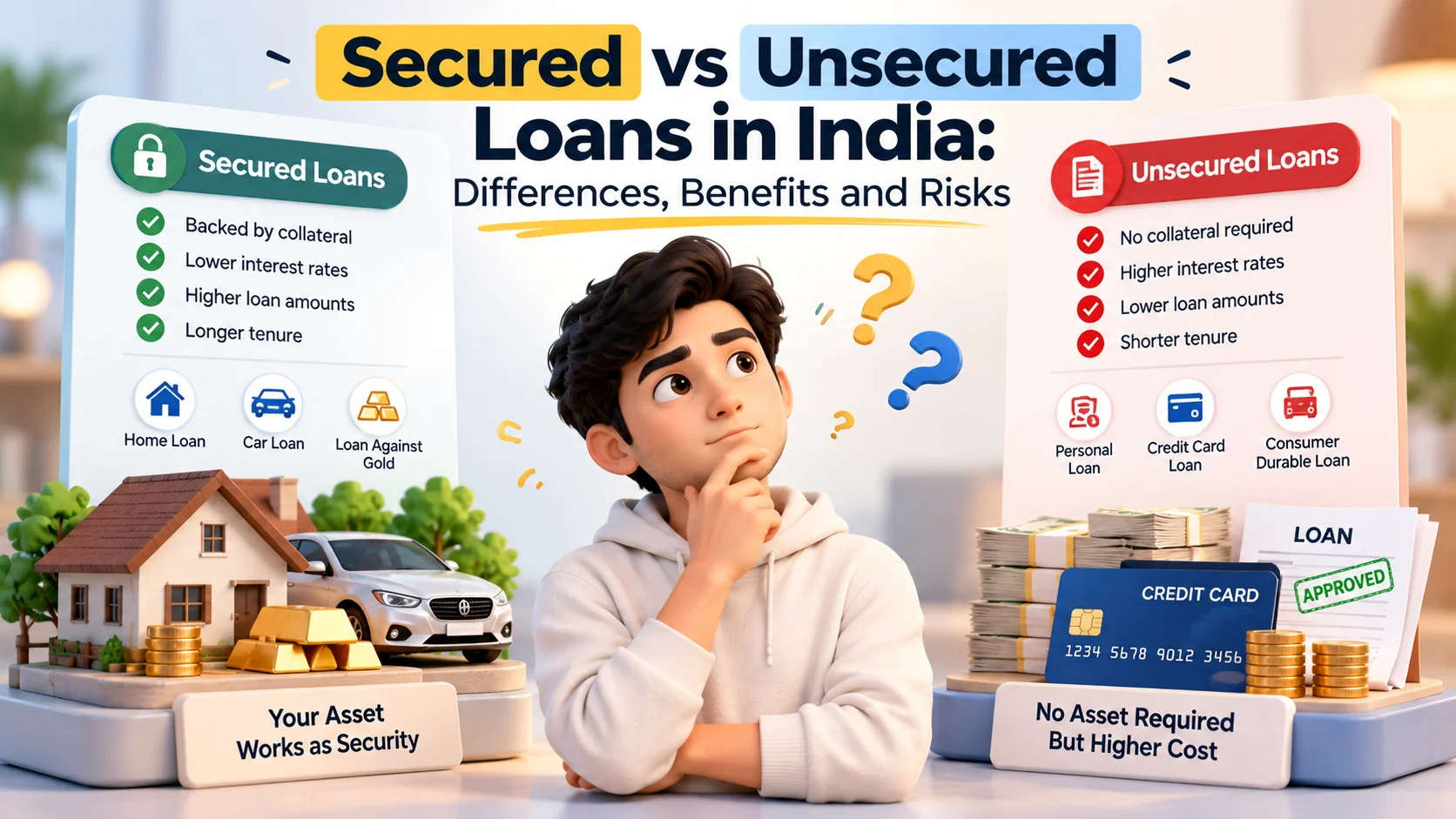
Understand secured vs unsecured loans in India, including collateral requirements, interest rates, eligibility, benefits, risks, and practical examples.
Grofi Editorial
Senior Financial Analyst