
Fetching financial insights...
•
•
•
•
•
•
RBI raised the repo rate to 5.50% in October 2026. Learn how the hike may affect home loan and personal loan EMIs, floating interest rates, and borrowers.
Grofi Editorial
Senior Financial Analyst
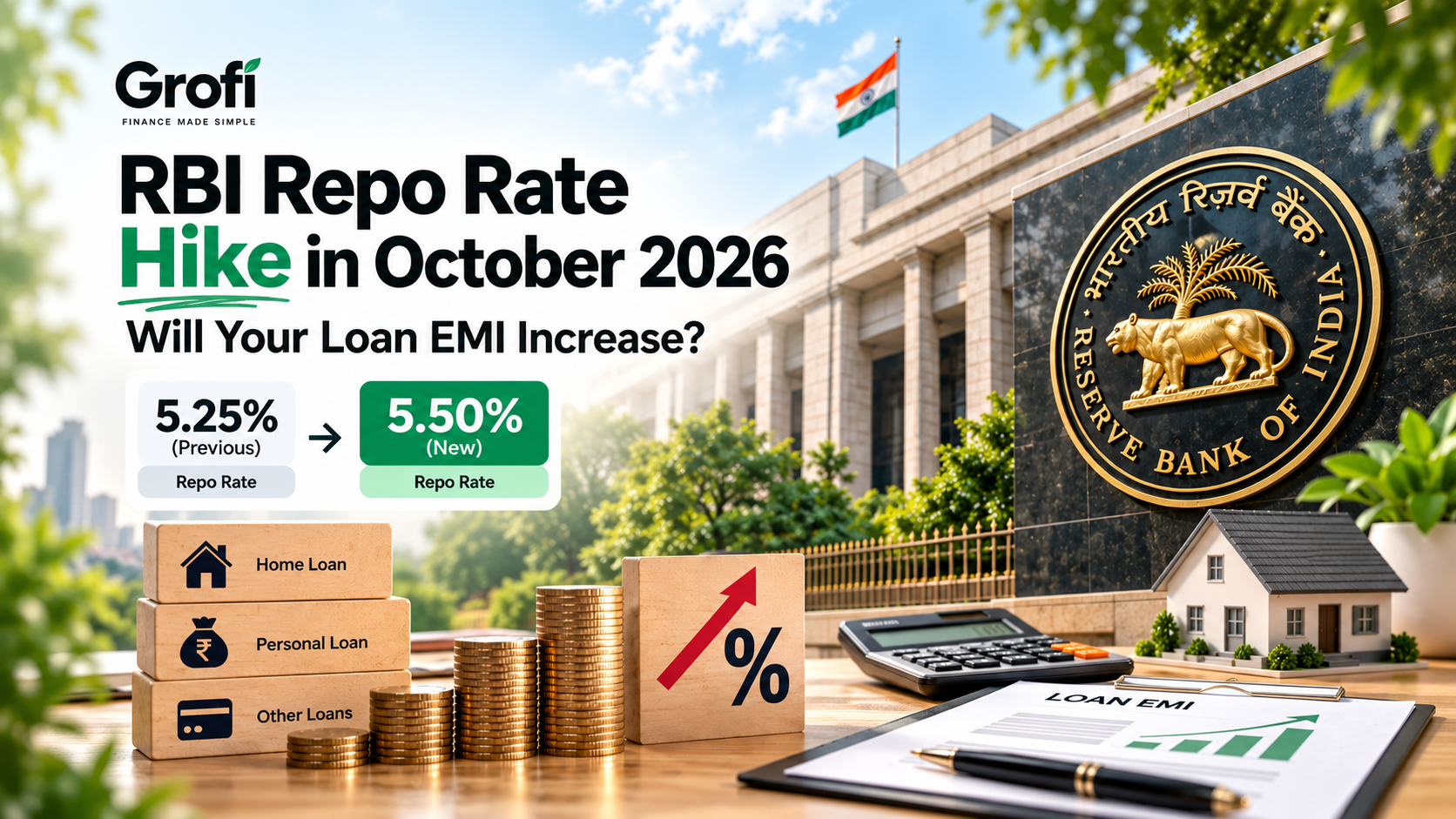
The Reserve Bank of India (RBI) has raised its policy repo rate by 25 basis points, bringing it from 5.25% to 5.50% on 7 October 2026. The decision marks a defined shift in the central bank's monetary stance as it responds to changing macroeconomic and inflationary pressures.
For millions of retail borrowers across India, this announcement immediately raises an important question: will monthly payments on home loans, personal loans, and other credit facilities become more expensive?
The practical answer depends on your lender, your loan's interest-rate regime, and the reset terms of your agreement. A repo rate increase does not automatically mean every borrower will face an immediate EMI hike. In this comprehensive guide, we unpack what changed, how benchmark rates transmit across commercial banks, which borrowers are directly impacted, and what steps you can take to protect your household cash flow.
The repo rate (Repurchasing Option rate) is the key interest rate at which the Reserve Bank of India lends short-term liquidity to eligible commercial banks against government securities under the Liquidity Adjustment Facility (LAF).
As the core anchor of India's monetary policy, changes in the repo rate directly influence interbank funding costs, lending rates, fixed deposit returns, and systemic liquidity across the broader financial economy.
When the RBI hikes the repo rate, commercial borrowing from the central bank becomes costlier. To preserve net interest margins (NIM), banks and Non-Banking Financial Companies (NBFCs) calibrate their benchmark lending rates upward. However, the transmission speed and financial impact vary notably across different loan products.
At its monetary policy meeting held from 5 to 7 October 2026, the RBI Monetary Policy Committee (MPC) voted to raise the benchmark repo rate by 25 basis points, accompanied by an adjustment across all related policy corridors:

Find out how much personal loan you can get on a ₹25,000 monthly salary in India. Explore eligibility, EMI examples, interest rates, and approval tips.
Grofi Editorial
Senior Financial Analyst
Swipe table to view more →
Alongside the 25 bps rate increase, the MPC revised its policy stance from 'neutral' to 'calibrated tightening'. The central bank highlighted persistent core inflation risks, elevated international crude oil prices, and global supply volatility as key factors necessitating a tighter stance to keep retail inflation within its 4% target band.
Not necessarily immediately, and not identically for all borrowers. The outcome depends primarily on the interest-rate benchmark governing your loan facility:
Under RBI regulations mandated in October 2019, all floating-rate personal, home, auto, and MSME loans disbursed by scheduled commercial banks must link to an external benchmark—predominantly the Repo Rate (termed Repo Linked Lending Rate or RLLR). If you took a floating-rate home loan after October 1, 2019, your loan rate will automatically reflect this +0.25% hike on your next scheduled reset date (typically scheduled monthly or quarterly).
Borrowers with floating-rate facilities sanctioned prior to October 2019 may still operate under the Marginal Cost of Funds-based Lending Rate (MCLR) or Base Rate frameworks. MCLR-linked loans do not move in automated lockstep with RBI policy; revisions depend on individual bank funding costs and each borrower's annual reset cycle.
If your loan contract has a genuine fixed interest rate for the entire tenure (common among vehicle loans, consumer durables, and certain personal loans), the October rate hike has zero impact on your existing EMI or repayment term. However, verify that your agreement does not contain a hybrid or reset clause allowing periodic rate reviews.
Home loans represent large principals repaid over extended timeframes (15 to 30 years), making them exceptionally sensitive to interest-rate shifts. When a 25 bps rate increase is transmitted, lenders typically implement one of three adjustments:
Important Note on RBI Guidelines: Following the RBI's fair lending circular on floating-rate loans, lenders cannot unilaterally stretch loan tenures indefinitely—particularly beyond a borrower's working age or retirement limit. Banks are obligated to give borrowers transparent options at every reset to choose between higher EMIs, extended tenures, or penalty-free partial prepayments.
The table below demonstrates the exact mathematical impact of a 25 basis point (0.25%) rate hike on an illustrative ₹50,00,000 home loan with a 20-year (240 months) remaining horizon, calculated using the standard monthly reducing balance formula:
Swipe table to view more →
Tenure Extension Cost Warning: If the borrower chooses to keep the monthly EMI static at ₹43,391 instead of paying the extra ₹795/month, the loan repayment period would automatically lengthen by approximately 11 to 12 additional months, incurring an additional ~₹4.8 Lakh in cumulative interest outgo.
The vast majority of retail personal loans are disbursed under fixed-rate contracts. If you have an existing personal loan on a fixed agreement, your EMI is locked in and will not fluctuate with the October repo hike.
For prospective personal loan applicants, however, commercial banks and NBFCs frequently re-evaluate card rates and personal credit pricing based on their weighted marginal funding costs. Keep in mind that unsecured personal loan pricing is driven significantly by individual credit scores (CIBIL 750+) and employer categorization alongside base policy rates.
A repo rate hike is generally positive news for conservative savers and fixed-income depositors. Commercial banks typically raise fixed deposit rates to mobilize additional retail deposits when credit demand outpaces domestic liquidity.
However, rate revisions will not be uniform across tenures. Commercial banks tend to offer peak rates on targeted special buckets (e.g., 400 to 555 days) rather than across all maturities. If you plan to book an FD, compare offerings across public, private, and Small Finance Banks (SFBs).
The RBI Monetary Policy Committee raised the repo rate by 25 basis points from 5.25% to 5.50% on 7 October 2026.
No. Genuine fixed-rate contracts remain unaffected by policy benchmark revisions for the duration of their contractual tenure.
For every ₹10 Lakh of home loan debt over a 20-year term at current rate levels (~8.5%), the monthly increase is approximately ₹159. For a ₹50 Lakh loan, the EMI increases by ~₹795 per month.
Credit card Annual Percentage Rates (APRs) are unsecured revolving rates and are generally determined by card issuer risk frameworks rather than direct repo linkage. However, overall cost of revolving debt remains high (36% to 42% annualized).
The Monetary Policy Committee convenes bi-monthly according to the RBI annual calendar. Check the official RBI portal for exact future meeting schedules.
The RBI's October 2026 repo rate hike to 5.50% reflects a proactive stance toward macroeconomic stability and inflation containment. While floating-rate retail borrowers will face slight upward pressure on repayments, taking informed steps—such as opting for EMI adjustments over tenure extensions and leveraging structured prepayments—can effectively mitigate the long-term interest impact.
Explore Grofi for clear, data-driven financial guides, loan calculators, and credit comparisons to help you navigate India's evolving lending landscape.

Learn about personal loan eligibility in India, including income, CIBIL score, employment, existing EMIs, required documents, and factors affecting approval.
Grofi Editorial
Senior Financial Analyst