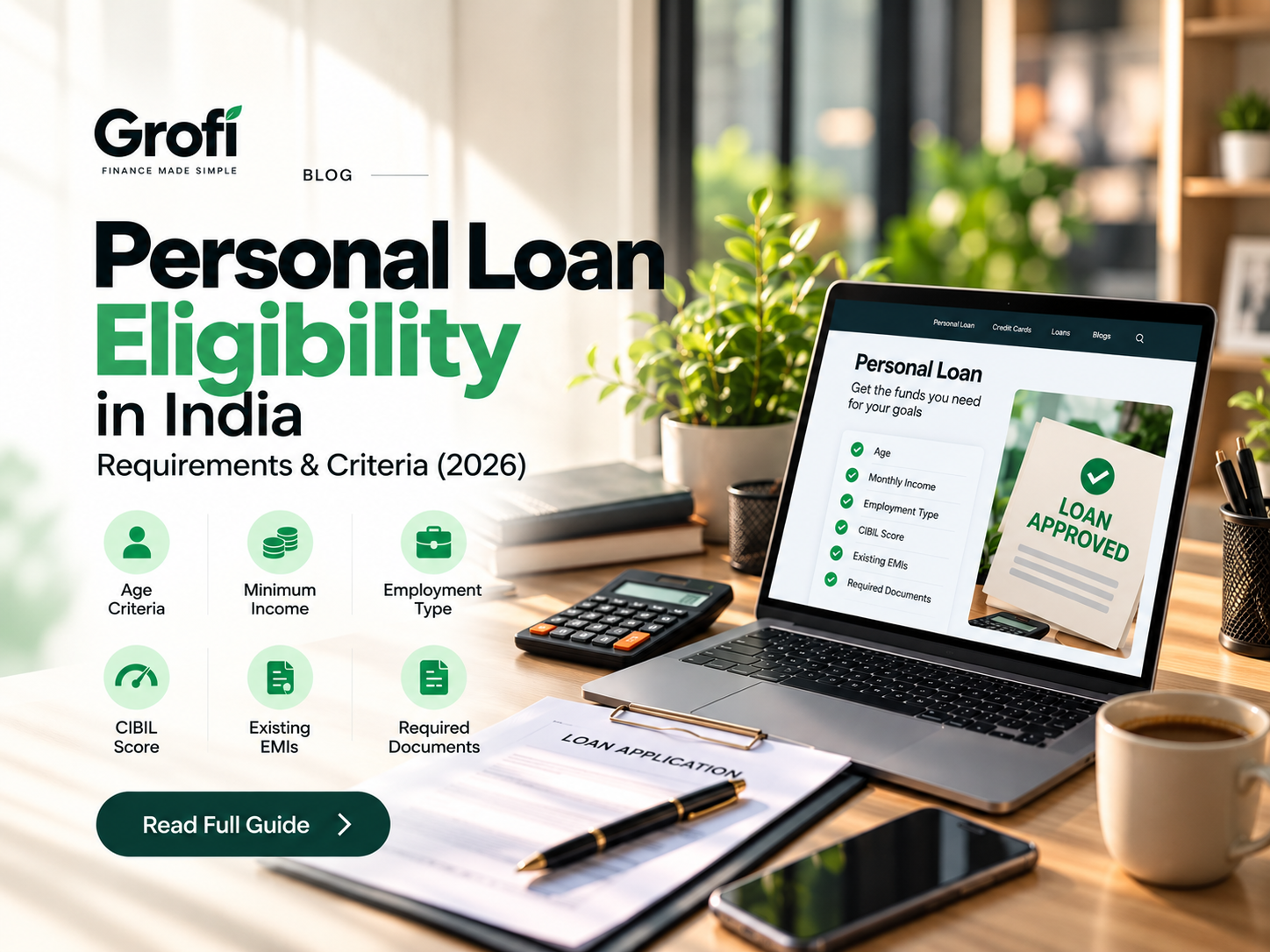
Personal Loan Eligibility in India: Requirements & Criteria (2026)
Learn about personal loan eligibility in India, including income, CIBIL score, employment, existing EMIs, required documents, and factors affecting approval.
G
Grofi Editorial
Senior Financial Analyst
Editorial Fact-CheckedVerified
Need money for a medical expense, home renovation, education, travel, or another important financial requirement? A personal loan may help cover planned expenses without requiring you to pledge an asset as collateral.
However, getting a personal loan is not simply a matter of filling out an application. Banks and non-banking financial companies (NBFCs) evaluate several factors before deciding whether to approve a loan, how much to offer, and what interest rate to charge.
Understanding personal loan eligibility before applying can help you prepare your documents, assess your repayment capacity, and avoid unnecessary applications.
In this guide, we explain the key personal loan eligibility criteria in India, including income, employment, CIBIL score, existing EMIs, documentation, and practical ways to strengthen your application.
What Is Personal Loan Eligibility?
Personal loan eligibility refers to the conditions a lender uses to determine whether you qualify for a loan.
Because most personal loans are unsecured, lenders generally assess your ability and willingness to repay without relying on property or another asset as collateral.
Your eligibility may depend on:
Your age and residency status.
Your monthly income.
Your employment type and stability.
Your credit score and repayment history.
Your existing loans and financial obligations.
Your requested loan amount and repayment tenure.
The lender's internal policies and risk assessment.
Every lender has its own eligibility criteria. Meeting the basic requirements does not guarantee approval, and the eligible loan amount may be lower than the amount you request.
Learn how to improve your CIBIL score with 10 practical tips, including timely payments, credit utilisation, credit report checks, and responsible borrowing.
Although requirements vary across banks and NBFCs, the following table summarises common eligibility factors.
Eligibility factor
What lenders generally assess
Age
Whether you meet the lender's minimum and maximum age requirements
Income
Whether your income is sufficient to support the proposed EMI
Employment
Job stability, employer profile, or business income consistency
Credit score
Your credit history and repayment behaviour
Existing obligations
Current EMIs, outstanding debts, and other financial commitments
Residency
Whether you meet the lender's residency and address requirements
Documents
Whether your identity, income, employment, and banking details can be verified
Before applying, check the specific requirements published by your chosen lender. Do not assume that every lender follows the same minimum salary, age limit, or credit score threshold.
1. Age Requirements for a Personal Loan
Age is one of the basic eligibility factors considered by lenders.
Many lenders require applicants to be adults and impose minimum and maximum age limits. These limits can differ between salaried applicants, self-employed applicants, and different loan products.
For example, a lender may assess whether you have enough working years or a sufficient period of income to repay the loan before reaching its maximum eligible age.
What should you do?
Check the lender's age criteria before applying. If you are close to its maximum age limit, review the available repayment tenures and make sure the proposed EMI fits your financial situation.
2. Minimum Income Requirements
Your income helps a lender evaluate whether you can repay a personal loan alongside your existing expenses.
A higher income does not automatically guarantee approval. Lenders may also consider your location, employer or business profile, income consistency, monthly expenses, and existing EMIs.
There is no single minimum salary requirement that applies to every personal loan in India.
For example, one lender may accept an applicant with a particular monthly income, while another may require a higher income based on its product rules and risk assessment.
How does income affect your loan amount?
Suppose two applicants earn ₹40,000 per month.
Applicant A has no existing loan EMIs and relatively low financial commitments.
Applicant B already pays ₹15,000 per month towards existing loans.
Even though their incomes are equal, Applicant A may have more room in their budget for an additional EMI.
Lenders use their own affordability calculations to assess such differences. Your take-home income, other expenses, and repayment obligations all matter.
3. Employment Type and Stability
Lenders may assess employment stability because a reliable income source can support regular EMI payments.
Salaried applicants
For salaried applicants, lenders may consider:
Length of employment.
Current employer and employment profile.
Monthly take-home salary.
Consistency of salary credits.
Employment gaps or recent job changes.
Changing jobs does not automatically make you ineligible. However, some lenders may have specific requirements regarding time spent with your current employer or total work experience.
Self-employed applicants
Self-employed applicants may be assessed using factors such as:
Business continuity.
Income consistency.
Bank statements.
Income tax returns.
Financial statements, where applicable.
Business registration or other supporting documents.
If you are self-employed, keep your financial records organised and ensure that the income declared in your application is consistent with the supporting documents.
4. What CIBIL Score Is Required for a Personal Loan?
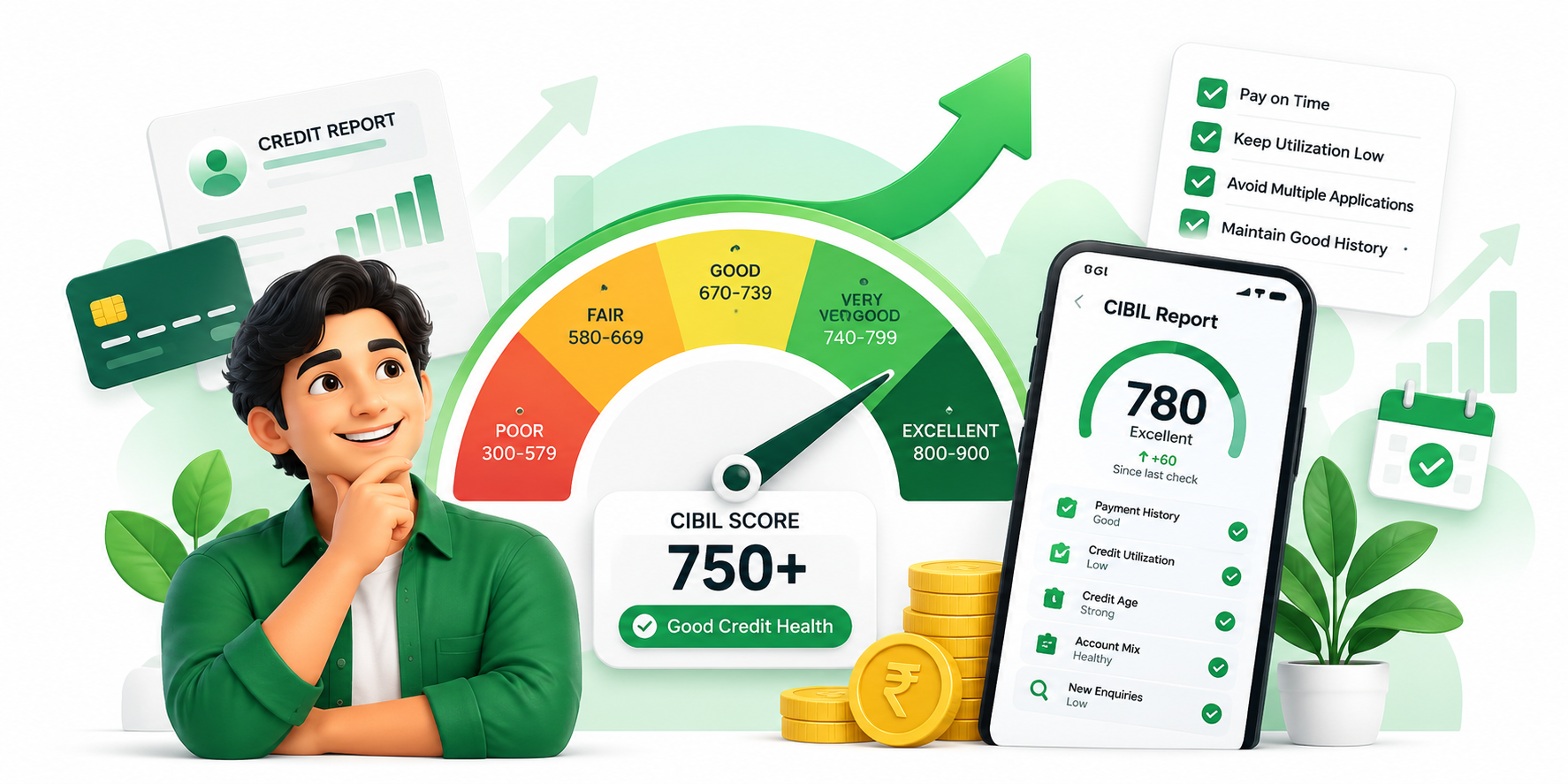
Your CIBIL score is an important indicator of your credit history. It generally ranges from 300 to 900, with higher scores usually reflecting a stronger credit profile.
Many lenders prefer applicants with good credit histories, and a score of 750 or above is often used as a general benchmark. However, there is no universal CIBIL score requirement for all personal loans.
Some lenders may consider applications with lower scores, depending on their policies and the applicant's overall profile. Approval, interest rates, and loan amounts may differ.
What if your CIBIL score is low?
Before applying, consider these steps:
Pay overdue credit card bills and EMIs.
Reduce high credit card utilisation.
Check your credit report for errors.
Avoid unnecessary credit applications.
Maintain timely payments on existing accounts.
These habits can support a healthier credit profile over time, but they do not guarantee approval or a specific score increase.
For more information, read our guide: How to Improve CIBIL Score: 10 Practical Tips for 2026.
5. How Existing EMIs Affect Personal Loan Eligibility
Your existing financial commitments influence how much additional debt you may be able to manage.
If you already have a home loan, vehicle loan, personal loan, or credit card obligations, the lender may account for those commitments when assessing affordability.
One commonly used measure is the fixed-obligation-to-income ratio (FOIR), which compares certain monthly financial obligations with income. Lenders may use different calculations and thresholds.
Example of monthly obligations
Suppose your monthly take-home income is ₹50,000.
Your existing loan EMIs total ₹12,000 per month.
Particulars
Amount
Monthly take-home income
₹50,000
Existing monthly EMIs
₹12,000
Income remaining after EMIs
₹38,000
The ₹38,000 remaining is not entirely disposable income because you still need to cover rent, food, transport, utilities, savings, and other expenses.
A lender may consider your remaining repayment capacity when assessing an additional EMI.
Practical tip: Before applying, calculate your household budget and choose a loan amount that you can repay comfortably, even if some unexpected expenses arise.
6. Documents Required for a Personal Loan
The documents required depend on the lender, your employment type, and the verification process.
Common documents for salaried applicants
PAN or another accepted identity document.
Proof of address, where required.
Recent salary slips.
Recent bank statements showing salary credits.
Employment details or other income verification.
Photographs or additional application documents, if requested.
Common documents for self-employed applicants
PAN and accepted identity documents.
Address proof.
Recent bank statements.
Income tax returns or other income records.
Financial statements, where applicable.
Business registration or business proof, if required.
Some lenders use digital verification and may request fewer documents. Others may require additional evidence.
Always submit genuine, accurate information through the lender's official website, app, or authorised channel. Never share your banking credentials, PIN, or OTP with someone claiming to guarantee loan approval.
7. How Loan Amount and Tenure Affect Eligibility
The amount you borrow and the period over which you repay it can influence your eligibility.
A larger loan generally results in a higher EMI for the same interest rate and repayment tenure. A longer tenure may reduce the monthly EMI, but it can increase the total interest paid over the life of the loan.
Consider two important questions before selecting an offer:
Can I afford the monthly EMI after accounting for essential expenses and other debts?
How much will I repay in total, including interest and applicable fees?
Do not select a loan only because the advertised EMI appears low. Compare the interest rate, processing fee, tenure, and total repayment amount.
You can also use a personal loan EMI calculator to estimate your monthly instalment before applying.
8. Common Reasons for Personal Loan Rejection
A personal loan application can be rejected for several reasons. The exact reason depends on the lender's assessment.
Low or limited credit history
A poor repayment record or limited credit history may make it harder for the lender to evaluate your creditworthiness.
Insufficient repayment capacity
Your income may not support the requested EMI after accounting for your existing financial commitments.
Unstable or unverifiable income
Frequent employment changes, inconsistent business income, or missing income records may affect the lender's assessment.
Too many recent credit applications
Multiple credit applications over a short period may raise concerns about increased borrowing needs.
Incorrect or inconsistent information
Differences between your application, identity documents, bank statements, and income records may delay verification or lead to rejection.
Internal eligibility rules
You may meet general eligibility requirements but still not qualify under a lender's internal policies.
If your application is rejected, review the reason provided by the lender, address any underlying issues, and avoid submitting multiple applications immediately without understanding the problem.
9. How to Improve Your Personal Loan Eligibility
You cannot control every part of a lender's decision, but you can take practical steps to prepare a stronger application.
Maintain timely repayments
Pay existing loan EMIs and credit card bills by their due dates. A consistent repayment record supports a healthy credit profile.
Reduce outstanding debt
Where possible, reduce costly outstanding balances and avoid taking on additional debt you do not need.
Check your credit report
Review your credit report before applying. If you find incorrect account details or payment records, raise a dispute with the relevant credit information company and lender.
Choose a realistic loan amount
Apply for an amount that fits your actual financial needs and repayment capacity. A smaller loan may result in a more manageable EMI.
Keep documents ready
Prepare accurate income, employment, banking, and identity information to make verification easier.
Compare lenders carefully
Eligibility requirements, fees, interest rates, and repayment terms differ. Compare suitable offers before submitting a formal application.
Avoid false promises
No agent or website can legitimately guarantee that a lender will approve your loan regardless of your eligibility. Be cautious of anyone asking for upfront payments in exchange for guaranteed approval.
10. How to Check Your Personal Loan Eligibility Before Applying
A simple preparation process can help you understand whether you are ready to apply.
Step 1: Review your income. Calculate your monthly take-home income and identify how much you can comfortably allocate to repayments.
Step 2: List existing obligations. Include loan EMIs, credit card payments, and other recurring financial commitments.
Step 3: Check your credit report. Review your repayment history, outstanding accounts, and enquiries.
Step 4: Estimate your EMI. Use a personal loan EMI calculator to compare possible loan amounts, interest rates, and tenures.
Step 5: Review lender requirements. Check age, income, employment, credit history, and document requirements for the specific product.
Step 6: Compare the total cost. Consider the interest rate, processing fee, other charges, and total repayment amount.
Step 7: Apply when ready. Submit accurate information through the lender's official or authorised application channel.
An eligibility calculator or pre-qualification check may provide an estimate, but it is not the same as final loan approval.
Frequently Asked Questions
1. What is the minimum salary required for a personal loan in India?
There is no single minimum salary applicable to all lenders. Requirements depend on the bank or NBFC, the loan product, your location, employment profile, and other eligibility factors.
2. What CIBIL score is needed for a personal loan?
Many lenders prefer applicants with stronger credit profiles, and 750 or above is commonly used as a general benchmark. However, the minimum accepted score varies, and some lenders may consider other aspects of an applicant's profile.
3. Can I get a personal loan with a low CIBIL score?
It may be possible with certain lenders, but approval is not guaranteed. A lower score may reduce your options or result in less favourable terms. Review your credit report and improve your repayment habits before applying where practical.
4. Can I get a personal loan if I am self-employed?
Yes, some lenders offer personal loans to self-employed applicants. They may evaluate business continuity, income records, bank statements, tax returns, and other financial information.
5. Does having an existing loan affect personal loan eligibility?
Yes. Existing EMIs and other financial obligations can reduce your available repayment capacity and affect the amount a lender is willing to offer.
6. How long does personal loan approval take?
The timeline varies by lender, application completeness, verification requirements, and the applicant's profile. Some digital applications may be processed quickly, while others require additional checks. Approval and disbursal are not guaranteed within a fixed period.
7. Can I apply for a personal loan without salary slips?
Some lenders may accept alternative evidence of income, such as bank statements or other financial records. Requirements depend on the lender and your employment type.
8. Does checking personal loan eligibility affect my CIBIL score?
Checking your own credit score is generally a soft enquiry and does not lower it. However, a formal credit application may trigger a hard enquiry. Confirm whether an eligibility check involves a credit bureau enquiry before proceeding.
9. Is a personal loan available without collateral?
Personal loans are generally unsecured, meaning they do not require property or another asset as collateral. However, eligibility, fees, and repayment terms still apply.
10. Does meeting the eligibility criteria guarantee approval?
No. Meeting the stated criteria is only one part of the process. The lender may also evaluate your credit report, income, existing debts, document verification, and internal risk policies.
Final Thoughts
Understanding personal loan eligibility before applying can help you make more informed borrowing decisions. Your income, employment stability, credit history, existing EMIs, and requested loan amount can all influence a lender's assessment.
Before applying, review your budget, check your credit report, prepare the required documents, and compare the total cost of available offers.
A personal loan should fit your financial needs and repayment capacity rather than create additional financial pressure.
Explore Grofi to learn about personal loans, compare financial products, and understand the factors to consider before choosing a lender. Eligibility, interest rates, and approval decisions depend on the relevant lender's criteria.
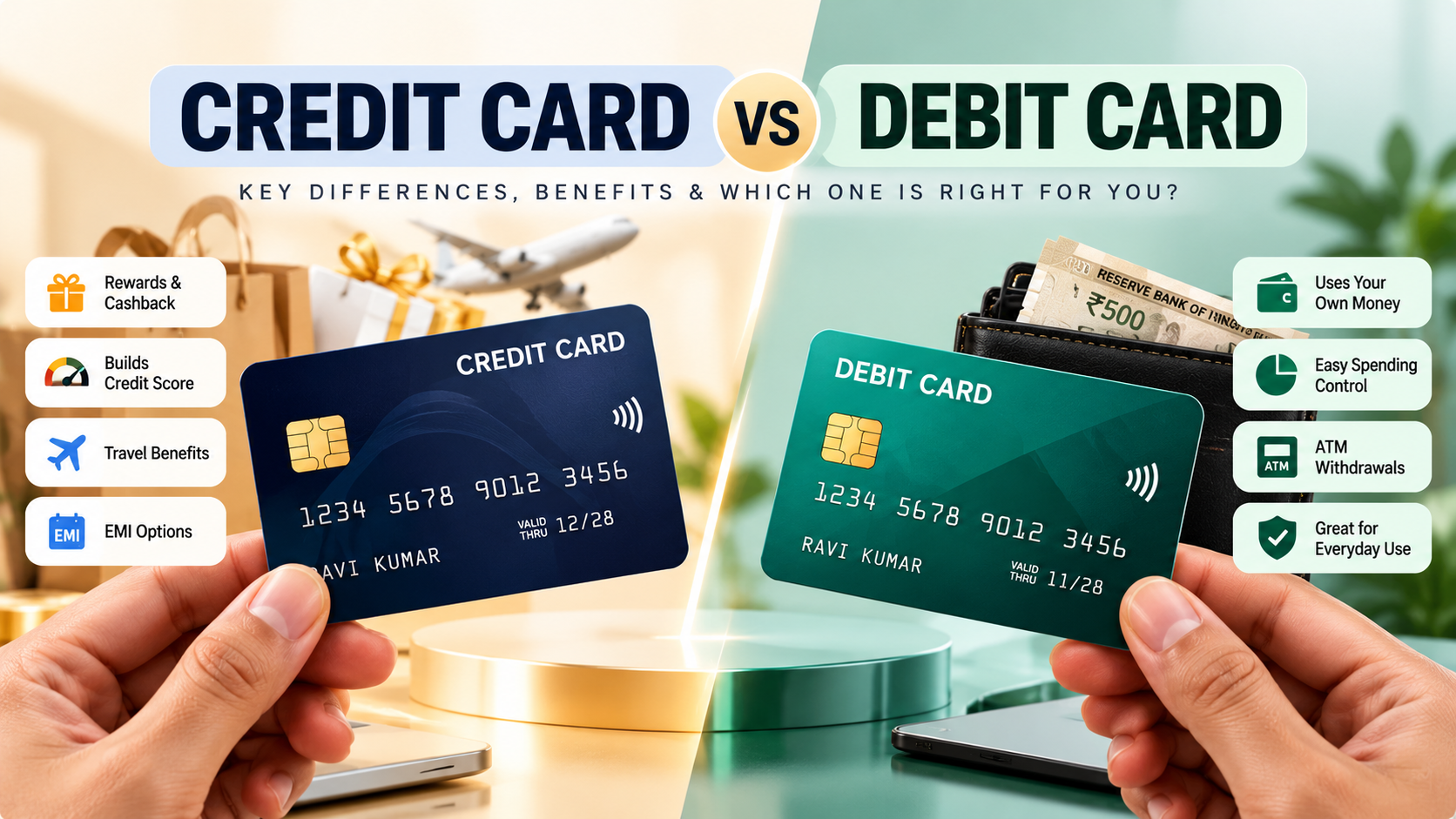
Learn the difference between credit cards and debit cards, including how they work, fees, rewards, credit scores, benefits, and which card is right for you.